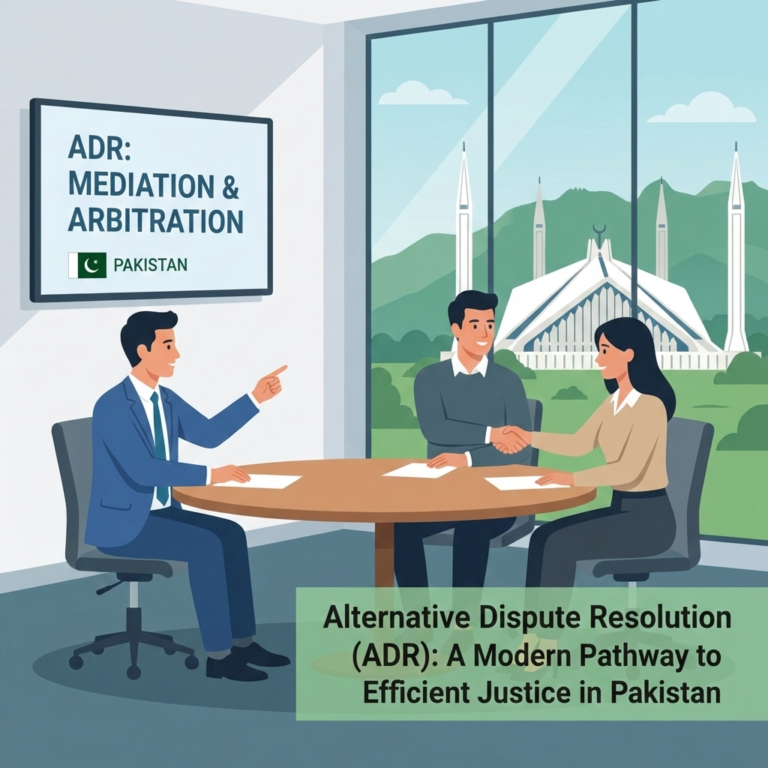
In recent years, Alternative Dispute Resolution (ADR) has emerged as one of the most discussed reforms in Pakistan’s justice sector. With courts burdened by millions of pending cases and citizens facing years of delay, ADR is seen as a promising solution to ease pressure on the judicial system while providing quick and cost-effective resolution of disputes. However, while ADR offers several advantages, it also presents challenges and limitations that must be understood before it can be relied upon as a mainstream mechanism for dispensing justice.
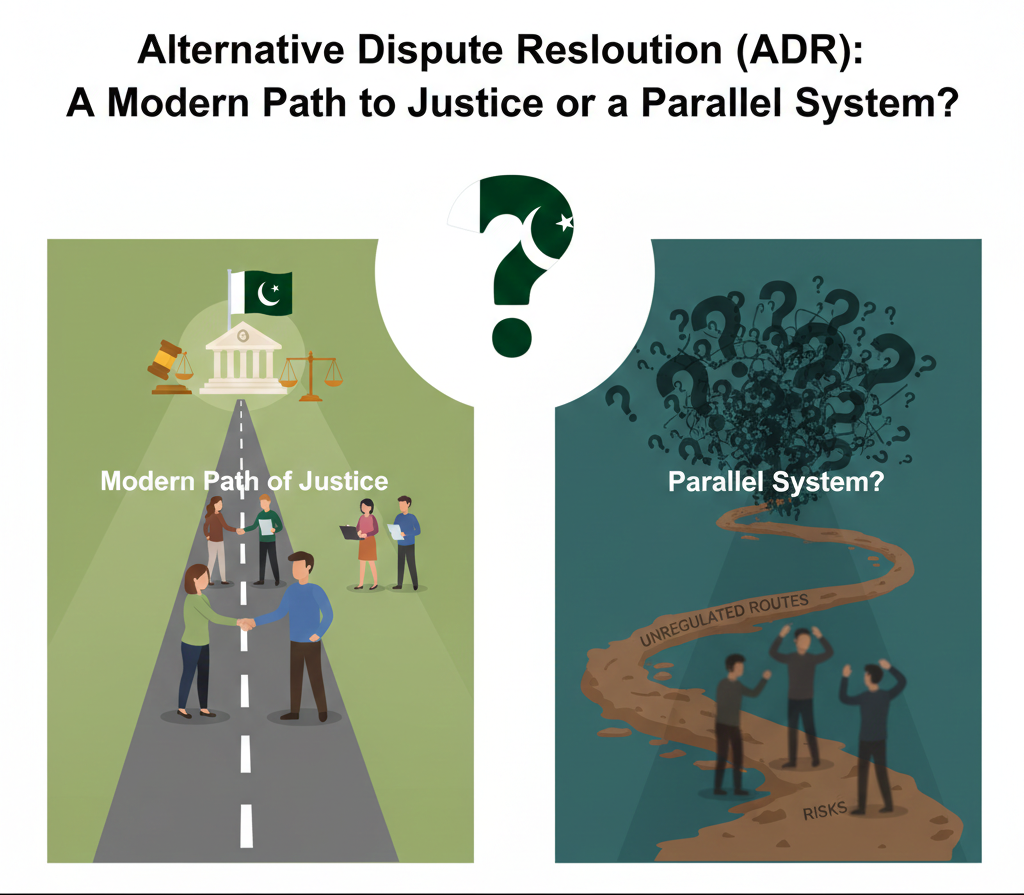
ADR refers to processes such as arbitration, mediation, conciliation, and neutral evaluation, where disputes are settled outside traditional courts by agreement of the parties. These methods are recognized globally and increasingly supported in Pakistan by recent legislation, including the establishment of mediation centres and arbitration-friendly laws. Yet the debate continues: Is ADR a modern path to justice—or does it create a parallel, unregulated system with its own flaws?
One of the greatest advantages of ADR is its speed and efficiency. Disputes that might take years in the courts can often be resolved within weeks or months through mediation or arbitration. For businesses, this speed reduces financial uncertainty and helps maintain commercial relationships. For ordinary citizens, it means quicker relief and reduced emotional stress. In a country where judicial delays are among the biggest obstacles to justice, the efficiency of ADR is undeniably attractive.
ADR is also less expensive than traditional litigation. Court cases often involve repeated hearings, procedural complexities, and substantial legal fees. In contrast, mediation or conciliation typically requires fewer sessions and less paperwork. This makes ADR accessible to individuals and small businesses that cannot afford prolonged litigation. Reduced costs also help avoid the financial burden that sometimes forces parties to abandon their legitimate claims.
Another major strength of ADR is its informal and flexible nature. Unlike courts, which are bound by strict procedural and evidentiary rules, ADR allows parties to structure the process according to their own needs. This fosters creative solutions that may go beyond the remedies available in courts. Mediation, in particular, allows parties to repair relationships, enhance mutual understanding, and reach solutions through dialogue instead of confrontation.
ADR also provides confidentiality, an advantage especially valued in commercial, family, and workplace disputes. Court proceedings, being public, often expose sensitive information. ADR sessions, however, allow parties to discuss matters openly without fear of publicity. This protects reputations, encourages honest negotiation, and helps maintain trust between parties.
Despite these strengths, ADR is not without its limitations and risks, many of which cannot be ignored. One significant concern is the lack of uniform regulations and professional standards, particularly in mediation. Unlike judges, many mediators or arbitrators do not undergo standardized training or certification. This can result in inconsistent quality and raise questions about fairness, competence, and accountability.
Another drawback is that power imbalances between parties may affect outcomes. In mediation, a stronger party—financially or socially—may pressure the weaker party into accepting an unfair settlement. While mediators try to ensure balance, the process relies heavily on voluntary consent, which can be compromised when one party wields disproportionate influence.
In arbitration, a key criticism is the high cost of institutional or commercial arbitration, especially when conducted by international arbitrators. While simpler local arbitration may be inexpensive, large commercial disputes can become as costly as formal litigation, sometimes even more so. This challenges the perception that arbitration is always cheaper.
There is also concern that ADR may lead to a parallel justice system that bypasses important legal safeguards. In some cases, parties may agree to ADR processes that lack procedural fairness or do not provide the same level of legal protection as courts. Critics argue that while ADR reduces court burden, it must not compromise constitutional guarantees such as the right to a fair trial.

A further issue is limited enforceability in some forms of ADR. While arbitral awards are enforceable through courts, mediated settlements sometimes face challenges during enforcement. If one party resiles from the agreement, the matter may ultimately end up in the court system, negating the benefits of ADR and causing additional delays.
Finally, ADR may not be suitable for all types of disputes. Matters involving criminal offences, constitutional questions, public rights, or complex legal issues cannot be resolved through ADR. Even in civil matters, when the dispute requires authoritative interpretation of law or determination of rights, courts remain the more appropriate forum.
In conclusion, Alternative Dispute Resolution holds immense promise for Pakistan’s justice system. Its advantages—speed, cost-effectiveness, flexibility, and confidentiality—make it an essential modern tool for resolving disputes. However, ADR is not a substitute for the courts; rather, it should serve as a complementary mechanism.
For ADR to function effectively, Pakistan must ensure professional standards, regulate mediators and arbitrators, protect weaker parties, and strengthen the enforceability of outcomes. A balanced and well-regulated ADR framework can reduce the burden on courts, promote settlement culture, and enhance public access to justice—while upholding fairness, transparency, and constitutional rights.
Zafar Rahim Sukhera
Advocate High Court Ex-Assistant Advocate General Punjab